Nov 03, 2025 Time TBA
Preserve Golden Valley For Future Generations
Mohave Cnty Mtg. Nov.03, 2025
700 W. Beale St Time: To Be Announced.
Please Try To Attend
Arizona, like most states in the western United States has been in an Extreme
Drought for several years. Developers want to build hundreds or even thousands of homes in Golden Valley. Mohave County recently flip-flopped on approval of these high density housing developments. In Early 2025 they turned down the Angle Homes plans, but several weeks later, in a closed-door meeting approved them. Concerned citizens uncovered this, and filed with the Planning Dept. and the B.O.S. admitted to violation of Open Meeting Regulations. They are now reviewing the approval with an open meeting with the public.
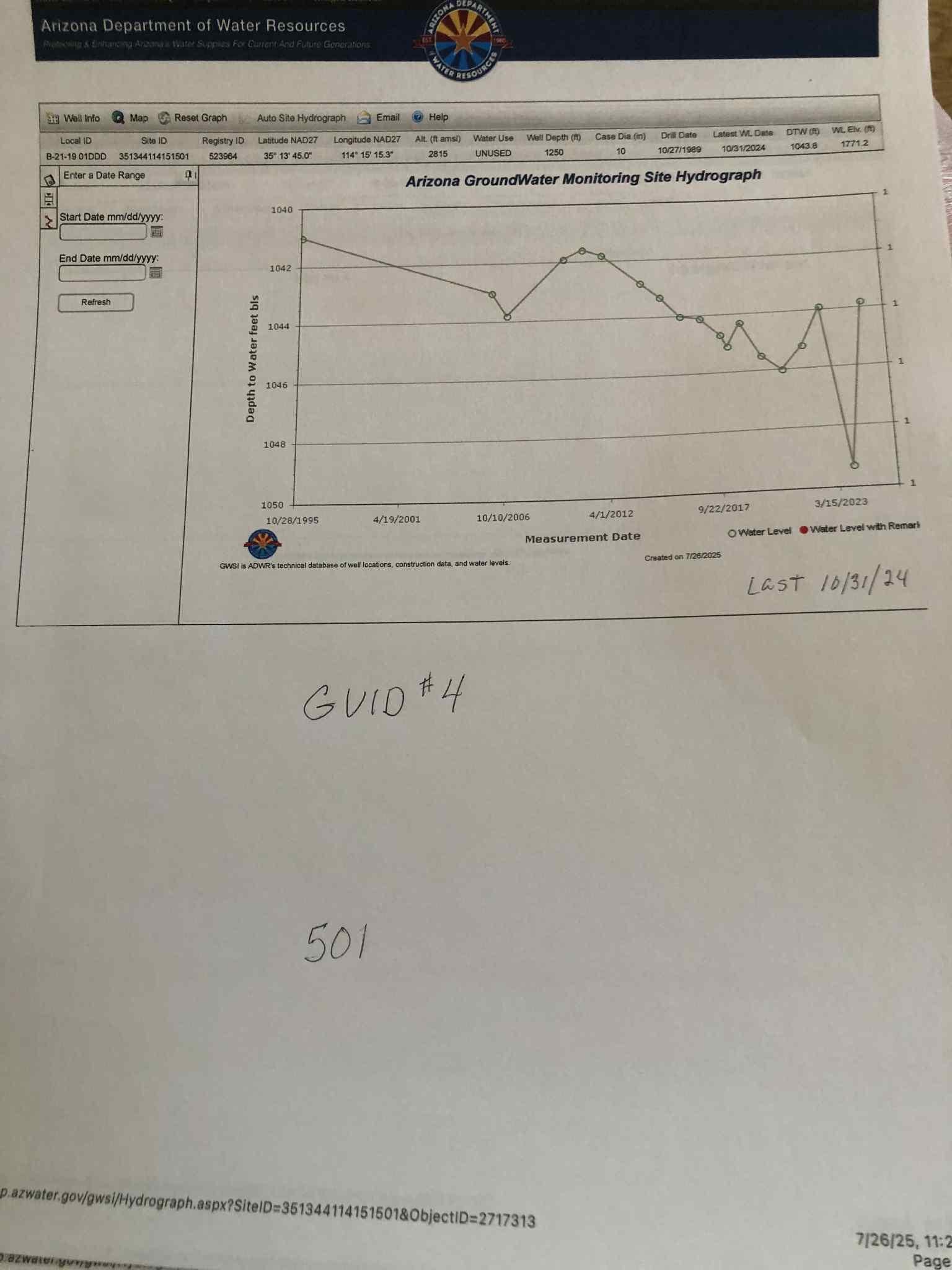
Golden Valley has been a A/R Zoned area for decades. The smallest land size is 1.1 Acres for each house. Angle Home developers have got approval from Mohave County Planning Dept. for more homes per acre. This website shows the charts of the Water Well conditions, which are dropping 1-ft. per year. Additionally, draught maps show Arizona long-term conditions to be worsening. .
TO: Interested Parties of Mohave County, Arizona
DATE: October 27, 2025
SUBJECT: Comprehensive Analysis of A.R.S. § 12-1134 (Proposition 207) Relative to the Proposed Angle Homes "Dorado" Project, Golden Valley, Mohave County
I. STATEMENT OF THE ISSUE
This memorandum analyzes the competing private property rights claims concerning the proposed "Dorado" residential project by Angle Homes. The developer is seeking a General Plan Amendment and a high-density rezoning from Mohave County to permit the construction of approximately 4,000 homes.
The County's decision is constrained by potential "regulatory taking" lawsuits under Arizona's Private Property Rights Protection Act (A.R.S. § 12-1134, or Proposition 207). This analysis examines the legal viability of two opposing claims:
1. A potential claim by the developer (Angle Homes) against the County if the rezoning is denied.
2. Potential claims by existing residents of Golden Valley against the County if the rezoning is approved.
This situation is complicated by the fact that the project site is located within the boundaries of the Golden Valley Improvement District (GVID), a public water utility.
Furthermore, the Mohave County Board of Supervisors (BOS) also serves as the GVID Board of Directors , creating a direct intersection between the County's land use and water management authorities.
II. APPLICABLE LAW AND GOVERNANCE
A. A.R.S. § 12-1134 (Proposition 207) Proposition 207 is a state law designed to provide "just compensation" to
property owners whose property value is diminished by government action.
? Core Provision (A.R.S. § 12-1134(A)): A property owner is entitled to "just compensation" if their "existing rights to use, divide, sell or possess private real property are reduced" by the "enactment or applicability of any land use law" , and this action reduces the property's fair market value.
? Definition of "Land Use Law" (A.R.S. § 12-1134(G)(4)): This is broadly defined as any statute, rule,
ordinance, or resolution by the state or a political subdivision that regulates the use or division of land ,
which includes a county's decision on a zoning application.
? Public Health Exemption (A.R.S. § 12-1134(B)(1)): The statute does not require compensation for a land use law that "limits or prohibits a use... of real property for the protection of the public's health and safety, including rules and regulations relating to... health and sanitation...".
B. Governance Structure Under Arizona law (A.R.S. Title 48), a county Board of Supervisors serves ex officio as the Board of Directors for county improvement districts. Therefore, the Mohave County BOS members act simultaneously as the legislative body for zoning and the executive board for the GVID water utility.
III. ANALYSIS A: DEVELOPER'S (ANGLE HOMES) POTENTIAL CLAIM (IF REZONING IS DENIED)
This scenario presumes the Mohave County BOS denies the developer's application , maintaining the existing low-density (e.g., A-R, Agricultural-Residential) zoning.
? The Developer's Claim: Angle Homes would argue that this denial is a "land use law" that reduces the property's fair market value by preventing its "highest and best use" (a 4,000-home development).
? Legal Weakness of the Claim: This position appears legally weak and tenuous for two primary reasons:
1. Prop. 207 Protects Existing Rights, Not Speculative Hopes: A.R.S. § 12-1134(A) is explicit that
compensation is owed only if existing rights are reduced. The developer purchased the land
subject to the established Mohave County Zoning Ordinance , which is primarily low-density "A-R"
(Agricultural-Residential) zoning. This low-density zoning is the developer's existing right. A denial
of the application does not reduce these existing rights ; it merely refuses to grant new rights
(high-density zoning) that the developer never possessed. The desire for an "upzone" is a
speculative investment goal, not a vested property right.
2. "Public Health and Safety" Exemption: As the GVID Board of Directors, the BOS has a fiduciary
duty to protect the health and safety of its existing ~3,950 GVID customers. The GVID system has
a finite capacity (reportedly ~950 acre-feet). The BOS can argue the denial is a land use law
exempt from compensation under A.R.S. § 12-1134(B)(1) because it is necessary to protect public
health and sanitation by ensuring the water utility's continued viability against a 4,000-home project
that would overload the system.
IV. ANALYSIS B: EXISTING RESIDENTS' POTENTIAL CLAIM (IF REZONING IS APPROVED)
This scenario presumes the BOS approves the developer's application, enacting a General Plan Amendment and a new high-density zoning ordinance.
? The Residents' Claim: This approval is the "enactment... of any land use law" as defined by the statute. Existing residents could then argue this new law directly reduces the fair market value of their existing properties, entitling them to just compensation.
? Legal Strength of the Claim: This position appears legally strong and aligns directly with the intent of
Prop. 207 , as it involves a government action that diminishes the value of established property rights.
? Basis for Diminution of Value: Residents would argue their property values are directly reduced based on several factors:
1. Destruction of Rural Character: The primary value of property in Golden Valley is predicated on
its low-density, rural nature. The introduction of a 4,000-home, high-density project fundamentally
alters and diminishes this character, a key component of its "fair market value".
2. Infrastructure and Service Strain: The existing road network (including Highway 68), emergency
services, and public utilities are inadequate for such a large population increase. The resulting
traffic and delayed emergency response would measurably decrease the value and desirability of
surrounding homes.
3. Water Resource Impact: In an arid region, water availability is intrinsically tied to property value.
The approval would create two distinct water-related harms:
¦ For Private Well Owners: The massive groundwater withdrawal required for 4,000 new
homes would place an unprecedented strain on the Sacramento Valley Groundwater Basin,
threatening the viability, reliability, and quality of existing private wells. This constitutes a
direct threat to existing rights, reducing property value.
¦ For GVID Customers: A resident's property value is tied to the reliability of its public water
service. Forcing GVID to service 4,000 new connections—a potential new demand of
1,600-2,000+ acre-feet per year (AFY) on a system with a ~950 AFY designation —would
threaten the entire system. This new law (the approval) would create a foreseeable risk of
system-wide water pressure failures , demands exceeding the utility's physical capacity ,
and massive rate hikes to fund new infrastructure, diluting the financial stability of all
existing customers.
4. Conflict of Law: Public records indicate GVID's operational rules are aligned with existing
low-density zoning. The BOS, acting in its legislative role, would be approving a zoning density that
it knows, in its GVID executive role, the water system was not designed to support. This action
would directly harm existing GVID customers and reduce their property values.
V. CONCLUSION: THE COUNTY'S LEGAL DILEMMA
Mohave County is positioned between two competing applications of A.R.S. § 12-1134 , presenting an
asymmetrical legal risk.
? If the County DENIES the project: It faces a legally weak but potentially expensive lawsuit from a single entity (the developer). This claim is based on speculative, non-existent rights and can be strongly
defended on two grounds: (1) no "reduction" of existing rights occurred , and (2) the denial is exempt
under the "public health and safety" provision (A.R.S. § 12-1134(B)(1)) to protect the GVID water system.
? If the County APPROVES the project: It enacts a new land use law and faces legally strong and
widespread lawsuits from a multitude of existing property owners (the residents). These claims are based on a quantifiable reduction of their vested property rights and the plain text of A.R.S. § 12-1134, which was intended to protect existing homeowners from government actions that devalue their property.